Anne Beaulieu
Research and Publications
Books
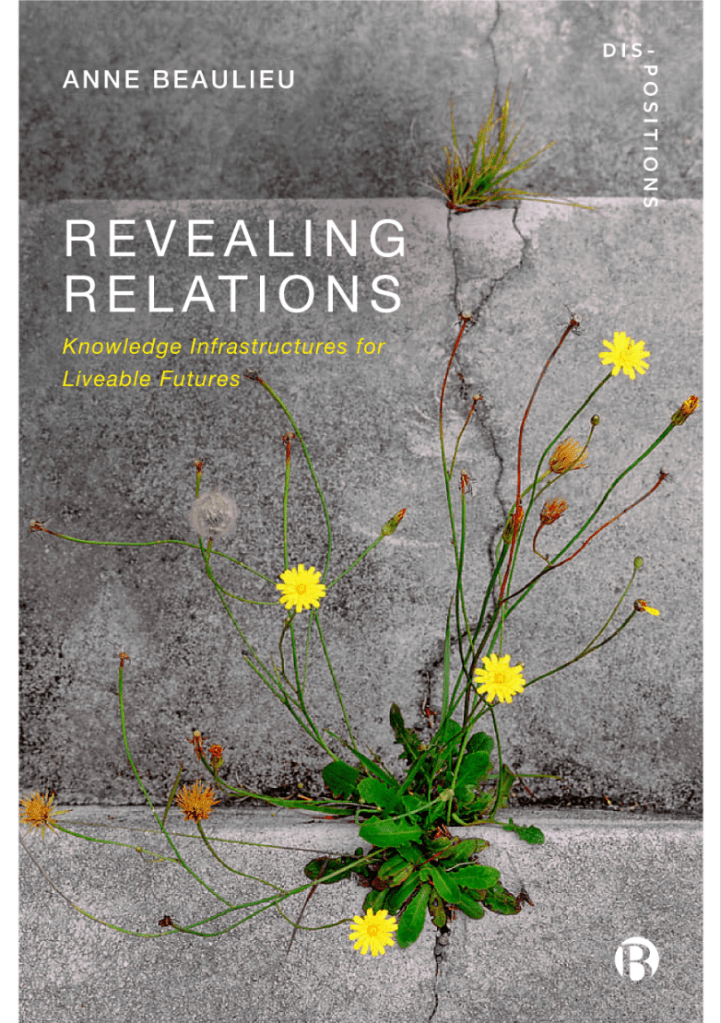
Current book project (in press, February 2026)
What kind of knowledge do we need for liveable futures? This book addresses this urgent question by focusing on the infrastructures that shape knowledge creation and circulation. Current knowledge infrastructures in Western science tend to be uniform in their design and aligned to specific social forms such capitalism and colonialism. They set out hierarchies of knowledge marked by globalism, abstraction and universalism, and reinforce views of nature as a resource. Because knowledge infrastructures are built around techniques that hide relations and maintain distinctions (for example between species, nature and culture, or knowledge and action), the knowledge they produce and circulate is unsuitable to contribute to liveable futures.
This book provides a toolbox to identify these techniques and clarifies how knowledge infrastructures shape relations to the material world. It also explores some of the powerful counter-currents situated at the margins of existing knowledge infrastructures or at the heart of projects designed to provide alternatives, including citizen science, digital and environmental humanities, feminist art, ethnography and reflexive uses of AI. These cases show that when relational aspects are foregrounded (such as context, attachment, arts of noticing, discernment and transformative encounters), knowledge that is characterised by open-endedness, patchiness, partiality and accountability emerges. A number of hopeful strategies for engaged scholars and reflexive activists and designers are proposed, to set out a path towards development and use of knowledge infrastructures that make liveable futures possible.

In today’s digital society, a critical understanding of data is essential for all. Knowledge about data is often split into areas of expertise, so that processes that span algorithms, servers, users and institutions are rarely discussed coherently and accessibly. Data and Society: A Critical Introduction presents a set of concepts to assess how data shape science, policy and politics, including how data are turned into metrics that are used to make decisions. It connects data as a highly technological practice to broad social questions of evidence, innovation and knowledge.
Pre-print available via University of Groningen repository.
Book from Sage
Data and Society is used around the world in a number of courses, among them:
Data Ethics. Responsible data practices and value-sensitive design (INFOMDE), University of Utrecht 2024-2025.
Data and Society, STS.005/11.155/IDS.057
Spring 2022, MIT
Data as evidence, SOMINDW04, University of Groningen

Smart grids are a complex phenomenon involving new, active roles for consumers and prosumers, novel social, political and cultural practices, advanced ICT, new markets, security of supply issues, the informational turn in energy, valuation of assets and investments, technological innovation and (de)regulation. Furthermore, smart grids offer new interfaces, in turn creating hybrid fields: with the increasing use of electric vehicles and electric transportation, smart grids represent the crossroads of energy and mobility. While the aim is to achieve more sustainable production, transportation and use of energy, the importance of smart grids actually has less to do with electricity, heat or gas, and far more with transforming the infrastructure needed to deliver energy, as well as the roles of its owners, operators and users.
This book presents a cross-disciplinary approach to smart grids, offering an invaluable basis for understanding their complexity and potential, and for discussing their technical, legal, economic, societal, psychological and security aspects. Book from Springer.

Today we are witnessing dramatic changes in the way scientific and scholarly knowledge is created, codified, and communicated. This transformation is connected to the use of digital technologies and the virtualization of knowledge. In this book, scholars from a range of disciplines consider just what, if anything, is new when knowledge is produced in new ways. Does knowledge itself change when the tools of knowledge acquisition, representation, and distribution become digital?
Issues of knowledge creation and dissemination go beyond the development and use of new computational tools. The book, which draws on work from the Virtual Knowledge Studio, brings together research on scientific practice, infrastructure, and technology. . The contributors combine an appreciation of the transformative power of the virtual with a commitment to the empirical study of practice and use.
Book from MIT Press.
.
 Anne Beaulieu