Anne Beaulieu
Research and Publications
Authorship at WTMC annual meeting
|
Off to Trondheim!
For the closing conference Medical Images in Art and Science, a event to mark the end of the project Picturing the Brain.
My talk will be on ethnography in the lab. While I’m aiming for a set of slides that will be low on text, here is a paper that considers some of the starting points of ethnography in networked setting that I will be further illustrating in the talk.
Beaulieu, A., and S. de Rijcke. “Mediated Ethnography and the Study of Networked Images – or How to Study ‘Networked Realism’ as Visual Knowing.” Proceedings of the First International Visual Methods Conference, 15–17 Sept. 2009, Leeds, UK.
Big data as knowledge production
In this keynote presentation at the upcoming Swiss STS meeting in Lausanne , I will consider big data as a form of knowledge production that has developed in relation the changes we have observed in the past decades in terms growth, accountability, network effects and technology. From this analysis, the need to understand and coordinate kinds of formalisation and the focus on patterns detection as an epistemic strategy emerge as key features of big data as a form of knowledge production. This framing of big data, not only as a new ‘ object’ for science, but also as a set of practices, technologies and institutional arrangements enables us to design research programmes (such as Energysense) that go beyond the one-size fits all approach of many funding schemes and centres– while mobilizing the promissory potential of Big Data.
SLIDES:
Coming soon…Networked neuroscience: brain scans and visual knowing at the intersection of atlases and databases
Our chapter in Representations in Scientific Practice Revisited discusses the development of authoritative collections of brain scans known as “brain atlases”, focusing in particular on how such scans are constituted as authoritative visual objects. Three dimensions are identified: first, brain scans are parts of suites of networked technologies rather than stand-alone outputs; second, they are specified by means of a “database logic” that makes particular neurological features visible within a register of possibilities; and third, they serve as interfaces that open up a range of possibilities rather than stand in as fixed representations. By tracing how the very concept of the
authoritative image has been transformed, the chapter shows how visual knowing takes shape in
research practices and situates it in the digital and networked settings of contemporary science.
Gift for Infinity: vote for energy transition
Until the 30th of September, our pitch for research addressing success factors in the energy transition is featured in a short video on www.RUG400.nl.
We are very pleased that in the context of the 400th anniversary of the University of Groningen, and in particular, in the campaign ‘Gift for Infinity’, members of the public have put forth issues that are at the core of EnergySense.
By visiting this site, you can see the videos and vote for the research that will be sponsored in the course of the anniversary funding campaign. A nice opportunity to show and reinforce this line of work.
Researcher on the Roof
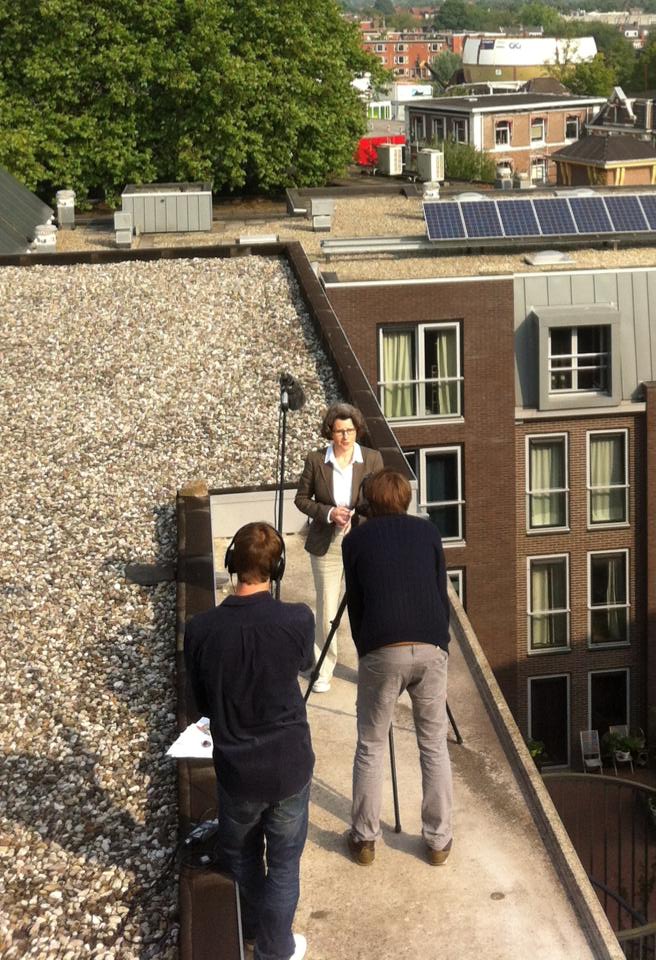
In the framework of the 400th anniversary of the University of Groningen, the public was asked to send in questions to the university. Several of these dealt with energy and sustainability, and together with some members of the public, a video was made to highlight the importance of these questions.
From Monday 2 September, the videos will be visible and you can all vote for the best research pitch. The winning topic will be the recipient of a funding campaign and be able to pursue the proposed research.
Navigating the brain
This Saturday, Sarah de Rijcke and I met up with artist and researchers Jordi Puig. We visited an exhibition data.scan [no 1-9] by Japanese artist Ryoji Ikeda at Gallery MU. A fabulous, immersive exhibition about data, in which multiple visualisations accompanied by sounds are juxtaposed, contrasted and combined. But the main reason for meeting up was to visit Jordi’s installation at STRP.nl festival. The work he presented is part of Picturing the Brain: Perspectives on Neuroimaging.


In the words of editor Tatjana Takseva: It is a pleasure to let you know that the collection Social Software and the Evolution of User Expertise: Future Trends in Knowledge Creation and Dissemination has been published.
It contains a chapter written with Karina van Dalen-Oskam and Joris van Zundert: Between tradition and web 2.0: eLaborate as social experiment in humanities scholarship.
There is also a chapter by University of Amsterdam colleague Jose van Dijck, Google Scholar as the Co-Producer of Scholarly Knowledge, which I’m also very much looking forward to reading.
PhD Defense in Sweden
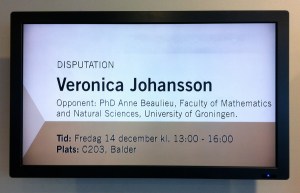 It was a real pleasure to serve as opponent at the defense of Veronica Johansson of the University of Boras, Sweden. We had a great discussion about ethnographic methods and about the concept of critical literacy. And as always, it was wonderful to see everyone rejoice at the new Dr’s great accomplishment.
The full work entitled ‘A time and place for everything: social visualisation tools and critical literacies’ and a summary can be found here.
 Anne Beaulieu